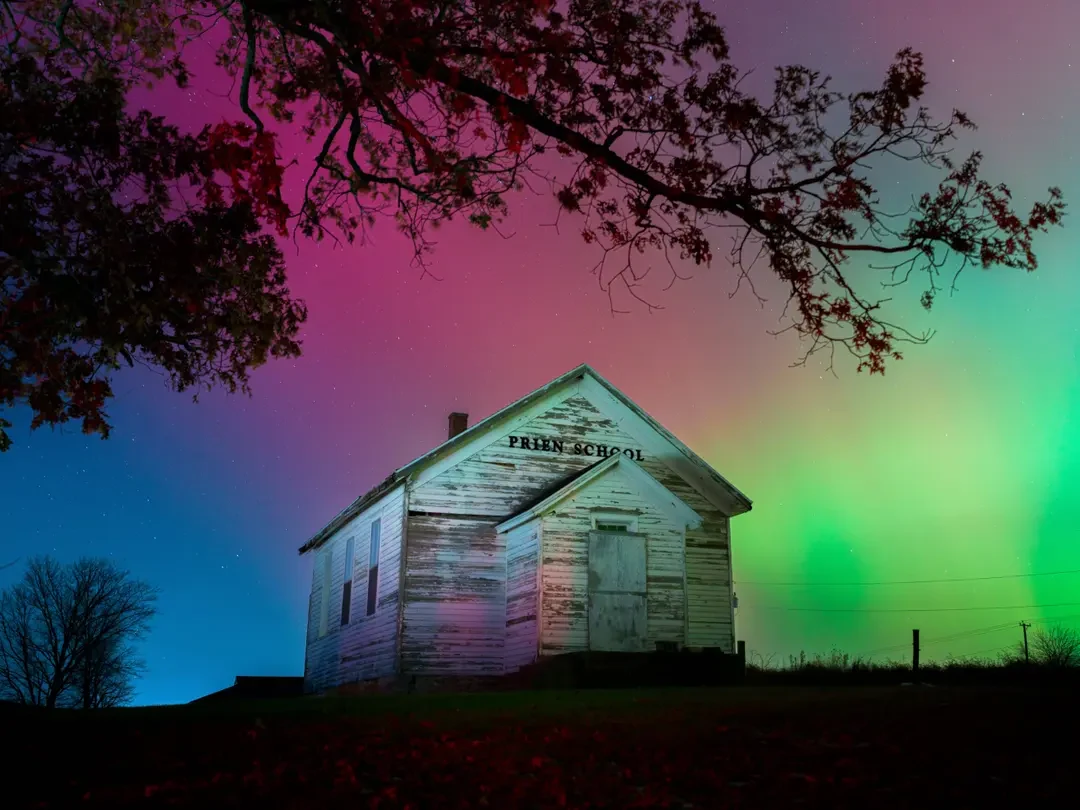
The Aurora Borealis lights up the night sky over Monroe, Wisconsin, on November 11, 2025, during one of the strongest solar storms in decades. The geomagnetic event pushes the northern lights deep into the continental United States, with vibrant pink, red, and green hues illuminating rural farmsteads and open fields across the Midwest. (Photo by Ross Harried/NurPhoto via Getty Images)(Photo: Getty)
UPDATE July, 30, 2026: Skywatchers could have the opportunity to spot the northern lights across North America tonight and tomorrow night, according to thelatest forecastfrom the National Oceanic and Atmospheric Administration’s (NOAA) Space Weather Prediction Center.
The northern lights made a rare appearance across numerous states in November 2025 with sightings reported as far south as Alabama and Florida, and as far northeast as New Jersey and Pennsylvania. Severe geomagnetic storms caused historic northern lights visibility during a 500-year activity peak in 2024, with the aurora showing up in southern and eastern states in late 2025.
Good news, if you missed this historic moment last year, you could get another another chance tonight to see the sky aglow in dancing streams of color.
The aurora borealis, or northern lights, could put on a show across a large portion of the northern U.S. again on Thursday, July 30, according to the National Oceanic and Atmospheric Administration (NOAA).
States That Could See Northern Lights on July 30
Based on thelatest NOAA aurora forecast map, these are the U.S. states that appear fully or partially above the aurora view line:
• Alaska • Washington • Idaho • Montana • Minnesota • North Dakota • South Dakota • Wisconsin • Michigan
Keep in mind that aurora forecasts can change, and the northern lights can sometimes barely show up, if at all. It’s a dazzling show, though, if myriad conditions align perfectly. The best time to see the northern lights tonight in the U.S. is between 10 P.M. and 2 A.M. local time, with the peak activity expected around 11 P.M. to 1 A.M. EST during a strong geomagnetic storm, according to NOAA’s Space Weather Prediction Center.
Check out NOAA’s Space Weather Prediction Center short-term forecast (~about 30 minutes) along with the last 24 hours of activity on theAurora 30-Minute Forecastpage, and SWPC’s newAurora Dashboard.
IN PHOTOS:Northern Lights Spotted Across the U.S.
Aurora Expert Tips for Watching the Northern Lights
According to our resident aurora chaser and astrotourism columnistStephanie Vermillion, last fall kicked off what could be thebest northern lights in decades.
This is because the sun has now reached its roughly 11-year peak of activity, known as “solar maximum,” she adds. “The bright star causes auroras by sending charged particles whizzing through space. When those electrons and ions crash into our atmosphere, they spark kaleidoscopic sky swirls that aurora hunters, like me, travel the world to see.”
While low-latitude auroras are indeed a rarity, some contiguous U.S. spots do see northern lights quite regularly during solar maximum, including the northern Great Lakes region,Outside’saurora hunter states. “I swear by Michigan’s Upper Peninsula, and many northern-border states.”
Vermillion offers her favorite tips for making the most of a once-in-a-decade aurora season, including:
Let your smartphone camera help you,notdisappoint you. Your camera is likely to show the northern lights more vividly than you’ll see them with the naked eye. So don’t expect to see thenorthern lights’ jaw-dropping displays like what you see on Instagram (especiallyVermillion’s Instagram), but do you use your smartphone or camera to monitor the sky. For your best chance to see the northern lights, try and get as far away from light pollution as possible. Then take test shots facing north to see if you can spot any green along the horizon. Most importantly, don’t forget to put the camera down, and be in the moment.
Vermillion also offers specifictips for how to take photos of northern lights with an iPhone.
According to our resident aurora chaser and astrotourism columnistStephanie Vermillion, this fall could bring thebest northern lights in decades: “This autumn is expected to kick off one of the strongest aurora seasons in decades—think last year’slow-latitude displays, and potentially even better.”
Vermillion offers her favorite tips for making the most of this once-in-a-decade aurora season, including:
 Georgia's Okefenokee Swamp Joins UNESCO World Heritage List—First U.S. Natural Site Added in Over 30 Years
 Think Highlining and BASE Jumping Are Only for a Few? These Guides Say They’re for Everyone.
 How a 1940s Baja Retreat Became One of the World’s Longest-Running Wellness Destinations